Aspects are the relationships between the planets and luminaries in a natal chart. Aspects can tell us about synodic cycles, or a dance, that planets perform together. There are times that planets are close and dancing together or maybe they are trying to dance in a crowded room and can’t really find their way to each other or the music is distorted.
“…aspects play a large role in describing what might be termed our ‘fate’ inasmuch as they describe what we have to deal with”
Sue Tompkins
Sue Tompkins, in her book: “Aspects in Astrology: A Guide to Understanding Planetary Relationships in the Horoscope” shares that “all the planets and points in the chart are ‘in aspect’ to each other. It is rather like a dozen or so people sitting around an elliptical table: each person is able to see every other, only from a different vantage point”(ch2, p.33).
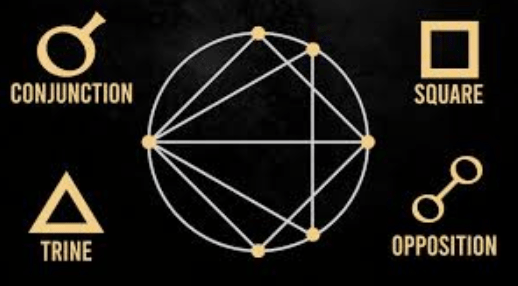
But unlike most dinner parties, the planets are always moving and changing seats and “…just as at a dinner party, one is more likely to talk to people seated in a certain relationship to oneself (seated next to or opposite, for instance), as astrologers we are used to thinking of some aspects as being more important than others”. Tompkins continues and lists the most prominent aspects as:
Unaspected planets do not have any of these common “degrees” and are by themself in the natal chart. Imagine an unaspected planet is sitting in the crowded dining room, but it is sitting alone at a different table.
And then then there is the discussion of The Orbs that can vary depending on the astrologer or the astrological school of thought.
Aspects are always measured by the shortest distance from planet to planet (or angle).
We can use the following arbitrary orbs:
eight degrees for a conjunction, opposition, trine, and square;
four degrees for the sextile, and
two degrees for every other aspect.
When we learn more about elements and modes…when we know if a sign is cardinal, fixed, or mutable and whether they are fire, earth, air, or water we can remember that:
cardinal, fixed, and mutable signs oppose (180°) and square (90°) themselves.
Fire squares Water and Earth – but opposes Air
Water squares Fire and Air – but opposes Earth
Fire sextiles Air; Earth sextiles Water (separated by one house or 60°)
In astrology, “aspects” refer to the angles that planets in a birth chart make to each other; for example, squares, trines and oppositions. Angles combine to make shapes; for example, rectangles, triangles and kites. These geometric shapes portray relationships between planets that are characteristically fluid and easy, or tense and challenging. Knowing these patterns helps us go with what’s flowing. It also helps us see where we´ll be called to rise to the challenge of tensions.
Find the shape of you with the geometry of your chart.




 The Power of Story