Layer by Layer
The Alchemy = Distillation | Pearl
Pour by Pour, Layer by Layer
We arrive at the last turning of the white.
In Justice we sorted. In the Star we rose. Now the work slows into something patient and circling. What we chose to keep is poured, and poured again, until it becomes more fully itself.
Temperance meets us at the water’s edge with two cups in her hands.
Distillatio – The Vessel That Returns
The historical alchemists had a vessel they called the pelican. Its curved arms reached back into its own body, so whatever was placed inside could rise, cool, and fall back to be warmed again. Nothing was lost. Nothing was hurried. The same substance passed through itself many times over.
Rising and Falling
In Distillatio the matter is gently heated. Its finer part lifts as vapor, touches the cool glass, and gathers as drops that return to the vessel below. Then it rises again. Each circling leaves behind a little more of what is heavy and carries forward a little more of what is essential.
Not Once
This is not the leap of the Star moon. It is repetition, the same motion made again and again until something changes in the doing. The historical alchemists sometimes poured what they had distilled back over what remained in the vessel and began again. They had a name for this returning, cohobation, and some described doing it many times over before the work was ready. Nothing new is added. The same matter meets itself once more, and each meeting is a little finer than the last. Distillatio asks us to trust the return, even when it feels like we have been here before.
The Whitening Completes
The Albedo has been teaching us to see. In Justice the white was clean and clear, the white of the cut. In the Star it became silver, reflecting what shone above it. Now Distillatio refines that seeing until it holds its own quiet light, a white that glows from within rather than giving back the world. Here the white deepens into luster, layer by layer. And somewhere far up the path, between two hills, we begin to sense the first warmth of the gold.
Two Cups
- We find two cups or small bowls and fill one with water.
- Standing or seated, we pour slowly from one to the other, and back again. We notice the sound, the weight shifting in our hands, the moment the stream thins.
- We let the pouring set our breath. Breathing in as the water rises in one cup, breathing out as it leaves the other.
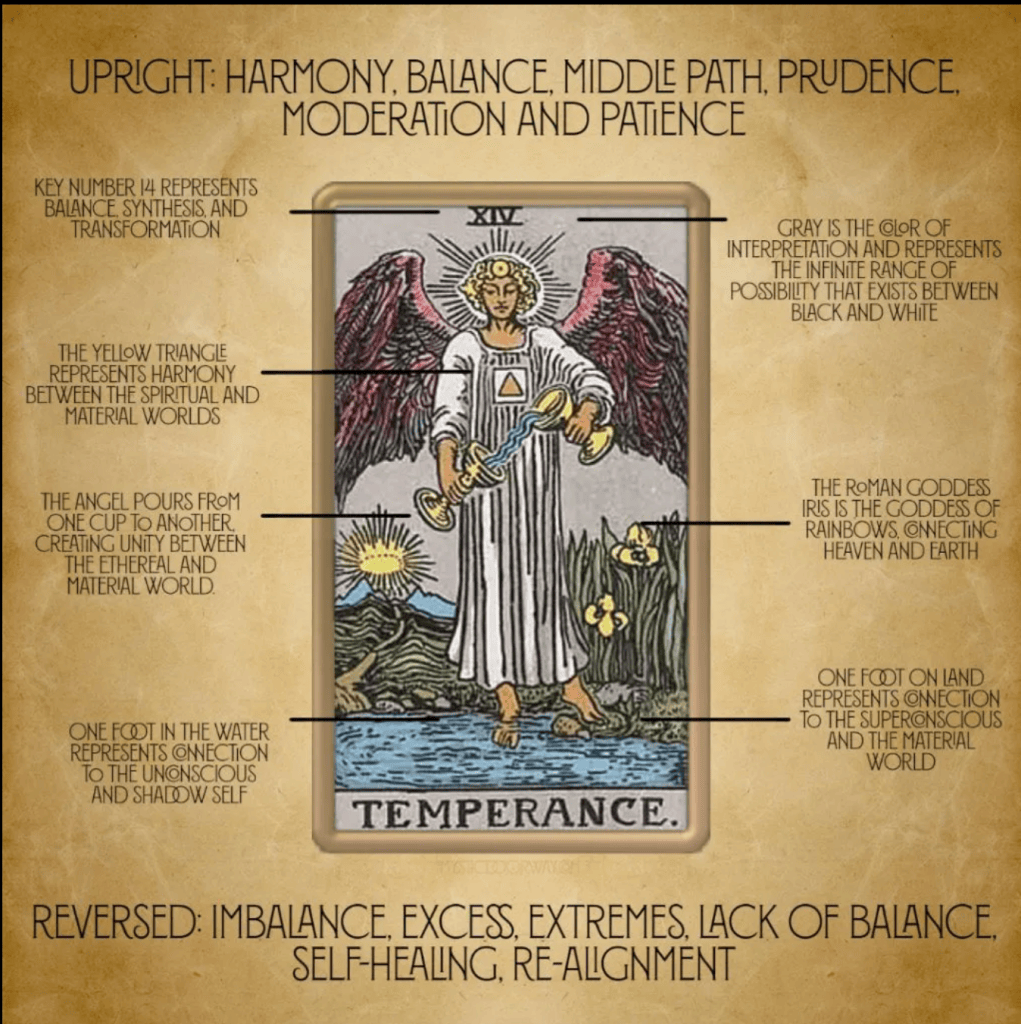
- If we are able, we stand with weight in one foot and then the other, the way Temperance stands with one foot on land and one in water. We feel how balance is never still, only a small continual return.
- We cup our hands together like two shells and rest them at our belly, the body’s own vessel. We stay with whatever has been asking to be held.
- When we are ready, we drink a little of the water, or pour it onto the earth.
The Tarot: Temperance
Temperance
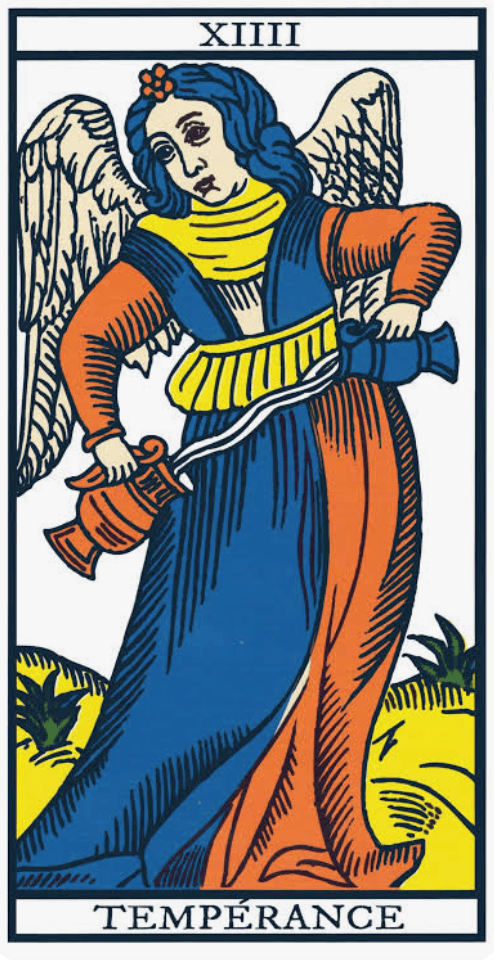
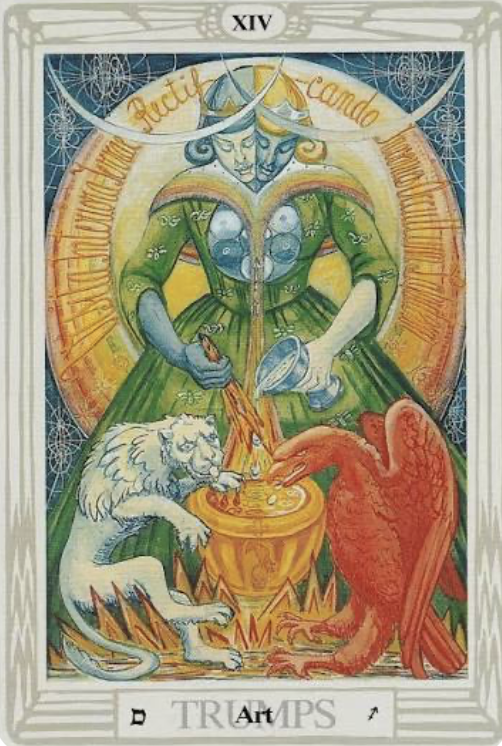
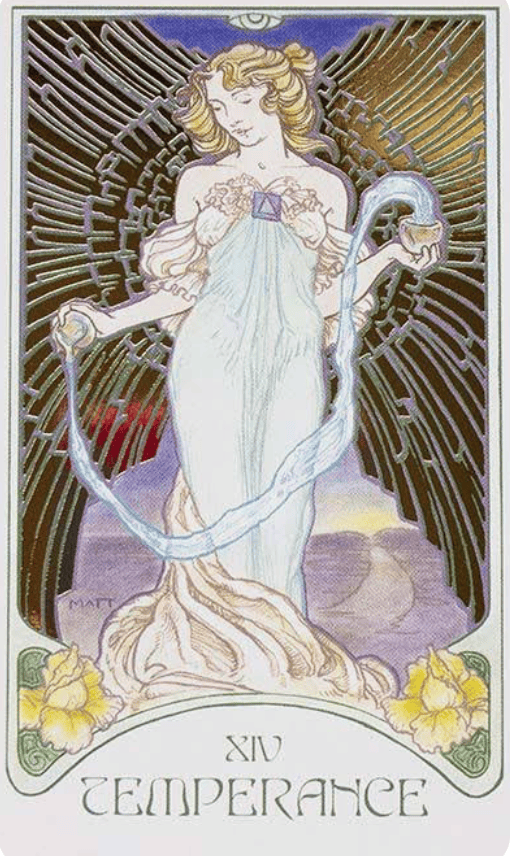
Temperance is the fourteenth card of the Major Arcana, and Mario Garza calls it the most alchemical card in the deck. Over the centuries she has carried many names. One early writer called her The Two Urns. The Golden Dawn named her the Daughter of the Reconcilers, the Bringer Forth of Life. In the Thoth deck she is simply Art.
Temperance is the in-between states of all things. It is neither one nor the other. … This angel comes to us to bring a softening to our hard edges. They show us that things cannot be so simply organized as we think. In attempting to do so, we may overlook the beauty that lives in the vast complexities of our world and ourselves.
Mary Elizabeth Evans, Apparition Tarot Guidebook (2018)
Two Cups, One Stream
A winged figure stands at the edge of a pool with one foot on the land and one in the water. She belongs to both, and she does not seem troubled by which is which. In her hands she holds two cups, and she pours from one into the other in a long unhurried stream. Look closely and the stream does something water should not do. It does not only fall. It seems to move both ways at once, rising as it pours, as if the cups were feeding each other.
Papus imagined her pouring from a golden vase into a silver one without spilling a single drop. Nothing is lost in her work, and nothing is wasted. Silver and gold meet in her hands, the silver we have been tending through these white moons and the gold that waits further up the path, already in conversation with each other before we arrive.
Ouspensky gave the angel another name. He called her Time. In his telling one cup holds the past and the other holds the future, and the rainbow stream between them is the present, flowing in both directions at once. We tend to imagine time as a river running only forward, but she shows us something rounder. What has been and what will be keep pouring into each other, and the present is the shimmering place where they meet. Everything returns to meet itself. Mario finds the same pouring written into the night sky. The Big and Little Dippers circle the pole star year after year, tipping toward one another as they turn, two vessels exchanging their waters without end. Distillation written into the heavens.
Papus also called Temperance the reflection of Justice in the material world. Two moons ago we stood with Justice, weighing and cutting, sorting the pile into what belonged to us and what did not. Temperance does not undo that work. She takes what was kept and begins to blend it in right measure, a little of this, a little of that, until the separate pieces can live together again. The sword makes way for the cup.
And she is the card of patience. Her pouring cannot be hurried. Pour too fast and the stream breaks and spills. Pour too slowly and nothing moves at all. She holds the measure between, steady and attentive, trusting the long work of time the way an oyster trusts the years it takes to make a pearl.
The Still Center
Mario offers the image of a wheel. Out at the rim everything turns and divides, and nothing holds still for long. At the hub all the spokes meet, and there the opposites are reconciled. He notices that angel and angle are only a letter apart, and that every angle of the wheel radiates from that one still point. Temperance comes from the center.
The Hebrew letter for this card is Samekh, which means prop or support. Mario likens it to the central pole of a tent, the one thing that keeps the canopy from falling so there is room to dwell inside. The world axis is that pole on a cosmic scale, joining heaven and earth. We carry one in our own spines. Sometimes we are the pole. Sometimes we need to lean on one.
Temperance belongs to Sagittarius, the centaur, half animal and half human, aiming its arrow. The wisest of the centaurs was Chiron, the wounded healer, who found his medicine by tending his own wound. Mario reminds us that the hardest part of archery is the letting go, and that the truest aim is inward, toward the center.
In the Thoth deck a rainbow arches over the figure, and in it runs an old alchemical motto whose first letters spell VITRIOL. Visit the interior of the earth, and by rectifying, find the hidden stone. Mario hears it plainly. We are the earth. The stone waits within.
Temperance is the coagula to the Lovers’ solve, as Lon Milo DuQuette puts it, the binding that answers the dividing. Here the Albedo gathers what it sorted and refined, and holds it at the still center, layer by layer, for the gold to come.