

Sorting into the Albedo
The Alchemy = Separation | White
Something has finished its work in the dark.
Not resolved, alchemy does not believe in resolution, but complete enough to release us into a different room.
That room is white.
Not the white of relief. The white of an eye adjusting after too long in shadow, everything overexposed for a moment before it comes into focus. This is the sorting, the first clear task after the burning, and clarity is not always gentle. It asks us to look closely at what remains and decide, grain by grain, what still belongs to us.
The Work of Separation
The alchemists called this operation separatio. It asks for a different kind of attention than what came before it. Not dissolving now. Discerning.
Before this phase, everything was mixed. Ash and bone and whatever else the fire left behind, all of it settled together in one undifferentiated layer. Nigredo does not ask us to sort. It only asks us to let things fall. Separatio comes after, once the falling is finished, and asks a harder question. Now that everything is down here together, what is actually what.
The Unglamorous Work
This is slow work, and it resists shortcuts. We cannot sort what we have not first laid all the way out.
Some of what we find will be immediately recognizable, ours, unmistakably. Some will look like ours and turn out, on closer inspection, to belong to someone else entirely, a fear we picked up secondhand, a rule we never agreed to but have been obeying for years. Separation is the long work of telling these apart, piece by piece, without rushing the pile.
The Color
White gathers here in its coldest, most exact form. Frost. Salt. A blade before it’s used. Bone stripped clean, not by violence but by time.
This is white with an edge. It does not soften what it reveals.
What We Set Down
We may find, at this threshold, that some of what has filled our hands for years was never ours to carry. This is not a moon for guilt about that. It is a moon for setting things down in their right pile.
Somatic Practice
- Sit with both hands open, palms up, the way Justice holds her scales. Notice what feels light enough to hold and what feels heavy enough to set down.
- Walk a short distance in a straight line, then retrace your exact steps backward. Notice what it takes to find the same path twice.
- Sort something small and physical, coins, buttons, stones, into two piles with no rule given in advance. Notice how the rule reveals itself as you sort, the way Justice’s verdict reveals itself only once all the evidence is weighed.
The Tarot: Justice
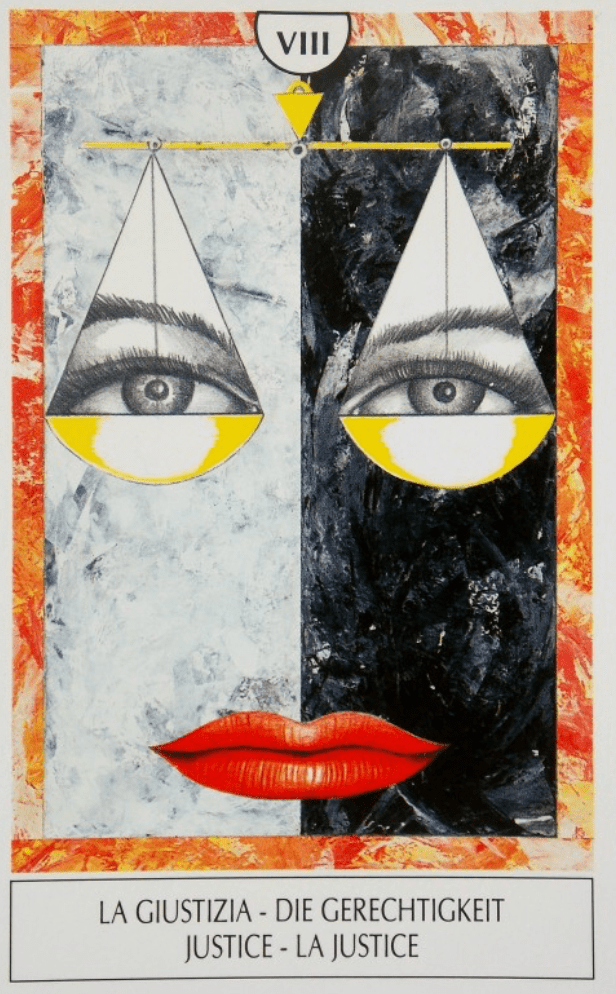
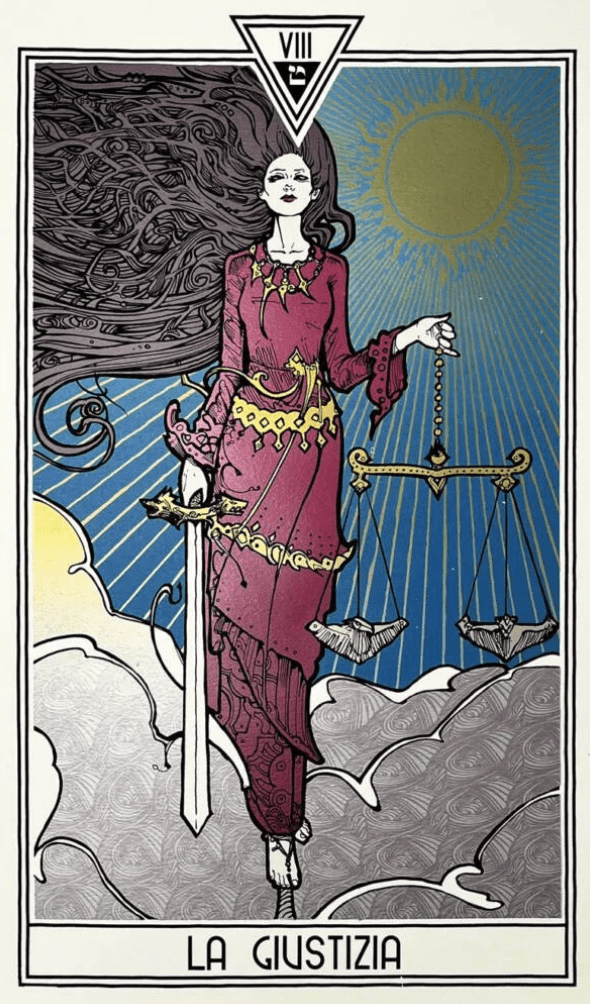
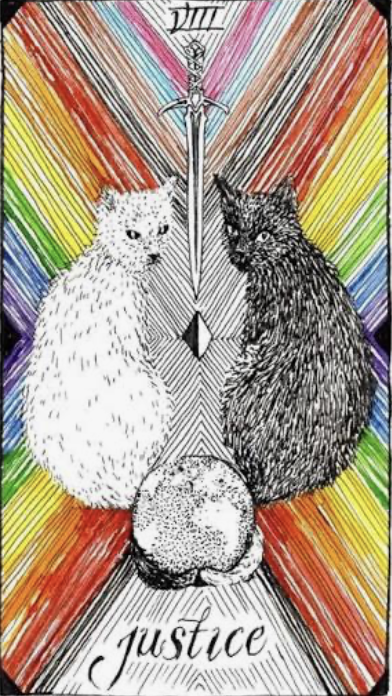
Scales and Sword
Justice looks straight out at us. Almost alone among the cards in this deck, she does not exist inside her own scene, absorbed in her own drama the way the Tower falls or the Moon dreams. She faces forward. She meets our eyes. This is not a card we watch from a safe distance. This is a card that asks us to account for ourselves.
That direct gaze is the mirror the Albedo promised. Silvering asked plain glass to become something capable of reflection, and here is the reflection, given a face. Justice does not show us a story to interpret. She shows us ourselves, weighed.
Her scales hold two things at once, without leaning toward mercy or harshness, until it becomes clear which is heavier. This is patient work, the same work the sieve does, gravity and time sorting what’s light from what’s dense enough to stay.
The sieve tilts, shakes, tilts again. Sand falls through. Salt stays. Weight is the only judge here.
But Justice also carries a sword, and the sword does something the sieve cannot. A sieve sorts what falls through on its own. A sword requires a choice. Some of what fills our hands will not separate itself by weight alone, no amount of shaking will make the decision for us. Justice’s blade is raised for exactly this, the discernments that ask something of us, that will not happen unless we’re willing to make the cut ourselves.
Her verdict does not flatter us and does not condemn us. It simply tells the truth, the way a mirror does, without softening what it shows.
Before the Cut
Justice does not ask us to choose between truth and balance. She asks us to notice they are the same motion seen twice.
Balance is what her scales do, holding two things steady until weight alone reveals the answer. Truth is what her sword does, cutting cleanly once the answer is known. One waits. The other acts. Neither works without the other. A truth spoken before the scales have settled is only an opinion dressed as a verdict. A balance held forever without ever cutting anything loose is not discernment, it is only indecision wearing patience as a disguise.
This moon asks for both. The waiting, and eventually, the cut.
Justice is the tarot’s card of honest reckoning: the clear-eyed assessment of what is actually true, stripped of narrative and self-protection.
PATRICK THE ORACLE GUY

Three Doorways
Ariadne’s Thread
Ariadne does not fight the Minotaur. She does not enter the labyrinth at all. She stands at the threshold and hands Theseus a single spool of thread, the means by which a path can be told apart from a maze.
This is separation as navigation rather than sorting. Not every discernment is a pile divided into categories. Some discernment is simply the thread that lets us find our way back out of what confused us, the line we lay down so that later, retracing it, we can tell the way forward from the way that only looked like forward. Ariadne’s thread and Justice’s scales do the same work in different hands, one marks a path, the other weighs a claim, but both exist so that clarity survives the maze.
We might ask where our own thread is. What in our life still marks true from tangled.
Szymborska, “Possibilities”
Wisława Szymborska wrote a poem built entirely as a sorting. This over that, stated plainly, one preference set beside another, an entire life assembled through small acts of choosing. [Read the full poem]
Where Ariadne’s thread marks a path already walked, Szymborska’s poem performs the sorting itself, in real time, on the page. It is less myth than method, watching someone separate what they love from what they merely tolerate, one plain sentence at a time, the way Justice weighs one thing against another until the scale settles.
We might ask what our own list of possibilities would say, if we wrote it as honestly as she did.
Clarissa Pinkola Estés, “The Faithful Gardener”
Estés tells of her uncle, a Hungarian refugee who survived the camps of wartime and came to America carrying almost nothing. When the land near his new home was cleared for a highway, he did not despair over what had been destroyed. He burned what remained and left the ground fallow. He waited.
She closes the tale by naming what she cannot fully explain, only that what seemed dead proves otherwise, and that fallow ground is not empty ground, only ground that is resting, waiting for its seed to arrive on the wind.
We might ask which of our own seeds we still trust, even lying in ground that looks fallow.
Clarissa Pinkola Estés
What is this faithful process of spirit and seed that touches empty ground and makes it rich again?
Its greater workings I can not claim to understand.
I only know that in its care, what has seemed dead, is dead no longer,
what is lost, is no longer lost,
that which some have claimed impossible, is made clearly possible,
and what ground is fallow is only resting – resting and waiting for the blessed seed to arrive on the wind with all Godspeed.
And it will.
The Ponderings:
- Where in your life is a pile still undivided?
- What have you been carrying that was never yours to sort?
- If Justice looked at what fills your hands right now, what would she ask you to set down?
What in this pile is truly mine?


