
Jungian Perspective on the Tarot
- Ken James offers a course on the JungPlatform that leads the participant toward Individuation using the Tarot as a guide in the inner work. One of the key goals of Individuation is to interact with others while making sense of the personal world.
- What happens when we interact or consult the Tarot? Ken James outlines the following benefits in his course: Jungian Perspective on the Tarot:
- Ego Relativization.
- “Lowering of the mental level” into a safe container.
- Deeper understanding of defenses (What do I want to learn?)
- Release resistance of what is happening in the personal world.
- Increase openness to non-Egoic determinants of experiences.
- Recognition of the “Transcendent Function” as an ally psyche section that gives rise to symbols in the forms of dreams, images, ideas. Symbols are are product of transcendent function.
What is the Tarot?
78 cards divided into two sections.
The Major Arcana represents the collective archetypal energies. The Minor Arcana is made up of four suits and are depictions of everyday situations and representations of the people in our lives. The term Arcana = Secrets.
Carl Jung wrote of the Tarot in his Visions Seminars – Volume 11 as a stream of the unconscious that can aid intuition as we try to understand the flow of life and possibly predict the future by reading into the conditions of the present moment.
As humans we want to find meaning. James shares that the outer and inner worlds are not as far apart as they seem since they come from the same source. Tarot can help us regulate because they are unitive.
The Tarot for Self
James introduces the Principles of Synchronicity as having these major points:
- Psyche is a structural reality which mirror the external world.
- The cards are a system of correspondence which operates between the psyche and the material world.
- It presents the Hermetic Axiom: “As above, so below”.
- Inner and outer realities meet in the symbols.
- The Tarot is a set of symbols, developed over time (can be found in recorded and traditional history) that serve to deepen awareness of both the inner and outer reality structures.
- Tarot can be used as evolved synchronicity and serves to revitalize the Ego and facilitate Individuation. It can act as a reflective pool – a mirror for the Self.
The Collective Archetypal Realm: The Major Arcana
There are 22 cards numbered from 0-21. The Fool is unnumbered as 0 and moves around the deck. The other cards are grouped into three cycles of seven. The first group is associated with Knowledge and Identity. The next is Understanding and Inner World, and the final seven are Wisdom and Deeper Consciousness.
The Fool (0) connects us to Self. The 0 is not as much a number as a symbol of a circle, mandala, and the emblem of the Self. When we are born we are an embodiment of Self and our development involves differentiation, reintegration, reunification, and inner work to reach Individuation.
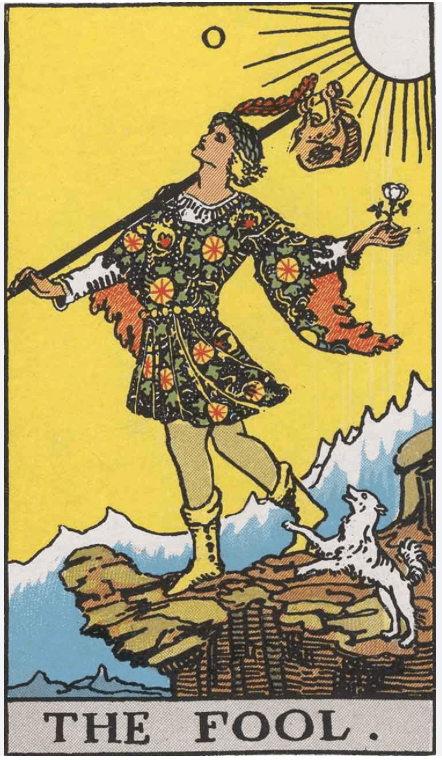
The Fool is fully equipped with all the tools she needs for her journey from the Minor Arcana. The stick over the shoulder represents the Wands and the sack holds a cup, a knife, and a pentacle. The sun is at his back so that he can see his shadow. The Fool is NO Fool, she can take a leap of faith into the adventures of life. The cliffs edge is a place of no worry or awareness and the dog is said to be instinct. The red feather is passion and the white rose is purity.
The Major Arcana can be explored in more detail by clicking HERE from Biddy Tarot.
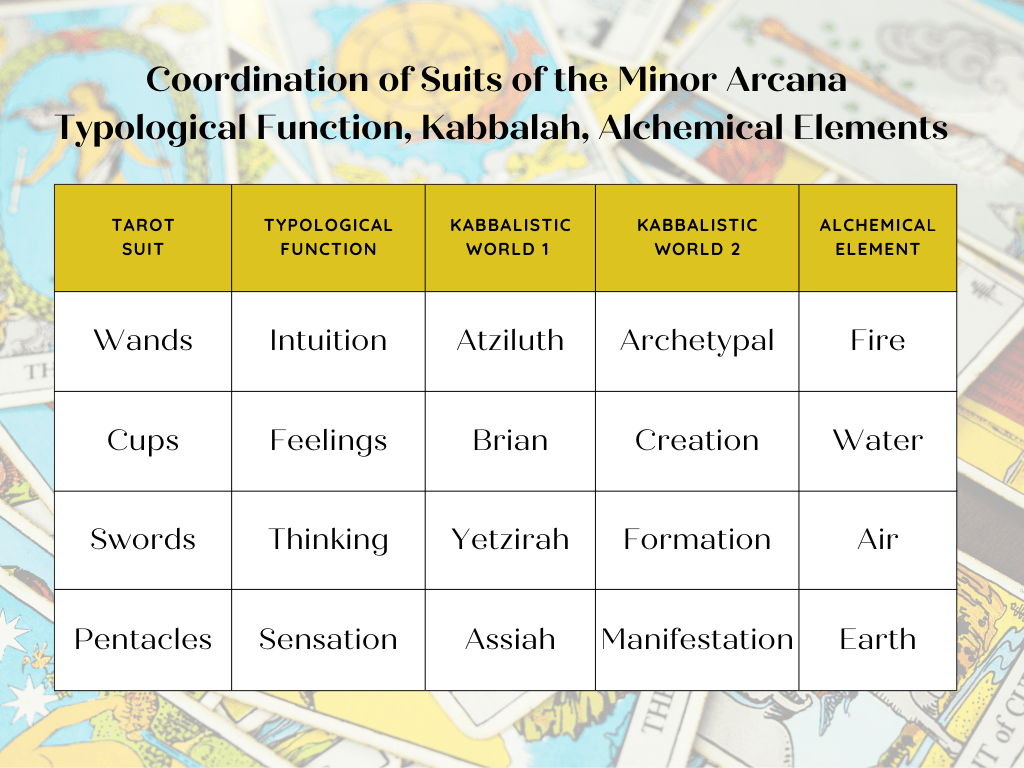
The Minor Arcana Suits are four sections called the Wands, Cups, Swords, and Pentancles and each has 10 Pips and 4 Court Cards. The pips are story scenes of personal events and situations while the Court Cards are relationships in the world and within the psyche. The chart below is a coordination of the suits, typology, Kabbalah, and the alchemical elements.
From the Ace to the 10th Pip card, each suit has its own story to tell. The Court Cards have their own features to correlate with steps on a journey: The Encounter, The Exploration, The Contemplation and The Expression. Pips are seeds. These are the seeds of personal development. Each of the Pip “numbers” explores a qualitative dimension. Tarot is meant to wake us up to things that we take for granted.
The Story of the Wands
There is a brilliant idea, we go on an adventure and we find a clear path. They welcome them and celebrate their arrival. But, there is conflict and then too much work and they are trapped by it and feel they have to carry the burden alone.
The Story of the Cups
The cup of life pours forth and two are joined together and then the community grows but is it too much? Is it wasted? Reflection is needed and a journey is required so they fill their own abundance and celebrate their completion.
The Story of the Swords
The sword starts the inner story which contains many symbols of blindfolds – perspectives. Crisis leads to a journey of deciding what is good and bad and realizing freedom is there when we release our restrictions and find our truths. The swords can overcome obstacles.
The Story of the Pentacles
The ideas invite us to go through the opening and create our prosperous destiny. There is a shift, a crisis, from individual to the greater good of the community. Through hard work (inner work) we can celebrate prosperity.
A Jungian perspective of Tarot hopes to inspire awareness of synchronicity. When we ask what our relationship is to the Suit, Court Card, or Pip we are using a Jungian approach. It is up to each “Reader” to decide how they want to read the symbols.
Tarot Vocabulary
Reader: The embodiment of the Self. The Self knows what the Ego does not know.
Querant: The question that comes from the Ego. It is the Ego’s relationship to the current situation. How can we have a better understanding of what is happening in our lives. These are discernment topics.
Shuffle: What life does to us.
Spread: Expression of the Transcendent Function
Throwing the Cards – Laying a Spread – Doing a Reading: The dynamic narrative insights of Self.
Writing the Fool’s Journey
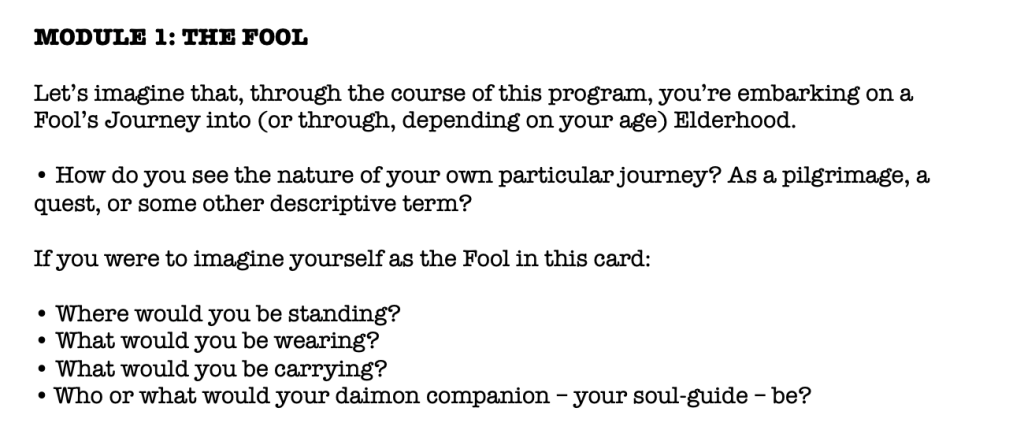
In Sharon Blackie’s Hagitude Program, she guides participants through a detailed understanding of the Major Arcana. Starting with The Fool, she provides prompts for the writer to consider and then apply to experiences from the first half of life to take a leap into the second half of life.
ACTIVITY: An example from the Hagitude program:
Tarot Resources
Tarot for the Wild Soul with Lindsay Mack
Oracle Decks by Kim Krans
Tarot and Individuation: A Jungian Study of Correspondences with Cabala, Alchemy, and the Chakras by Irene Gad
Personal Myths Home
 The Power of Story