The Missing Yellow
The Alchemy = Conjunction | Golden Yellow
A Short History of the Work
Alchemy began in Hellenistic Egypt, in the workshops of Alexandria, among people who dyed cloth, worked metal, mixed cosmetics, and embalmed the dead. They watched color change in their materials and believed that a change of color was a change of soul. Some of the earliest alchemists whose names we know were women, among them Maria the Jewess, and the writer Zosimos of Panopolis, who left one of the first surviving texts around 300 CE.
These early alchemists described the work in four colors: the blackening, the whitening, the yellowing, and the reddening. Jung traced these four back to the colors named by the philosopher Heraclitus.
The work traveled. Arabic scholars carried it forward, refining both its chemistry and its philosophy. In the twelfth century their writings were translated into Latin and entered medieval Europe, where alchemy took on Christian imagery and a language of kings, queens, and sacred marriages.
Somewhere around the fifteenth and sixteenth centuries, the yellowing quietly fell away. The four colors became three: black, white, and red. Hillman notices that this is just when alchemy itself began to come apart. Some of it hardened into gold-making for princes. Some rose into esoteric Christian mysticism and the Rosicrucian movement. Some became the laboratory science we now call chemistry. The soul of the work went underground.
Four centuries later Jung found it again, recognizing in the old texts the same images his patients brought him in dreams. And in 1989, speaking to a congress of analysts in Paris, James Hillman asked what had been lost when the yellow disappeared. His answer is the ground of this module.
The Forgotten Color
When the yellow dropped out, the path ran straight from white to red. From reflection to action. From understanding to doing. Without the yellow, Hillman warns, we take what we have seen in the quiet of the vessel and turn it too quickly into programs and missions in the world. The bridge is missing, and so is something of the soul.
Yellow Inside the White
One old text says that while the work whitens on the outside, it yellows on the inside. The gold has been growing all along, hidden in the belly of the white, the way a pearl hides its first grain of sand. We do not leave the albedo behind. The yellowing comes from within it.
When the White Refuses
An alchemist named Figulus wrote that matter brought to whiteness refuses to be corrupted. The white is cool and content. It has worked hard for its peace. So when warmth enters, it can feel like a spoiling, a loss of the clarity just won. Yet the same writers say the white stays lifeless until it warms. They called the yellowing a resurrection.
Mind Takes on Body
In the white, the mind and the body could go their separate ways. Reflection floated above, and the urgent, desirous body stayed below. The yellowing ends that separation. The alchemists named the two sulfur and mercury, and in the yellow they meet. Hillman’s image is milk becoming cheese, the white taking on body, flavor, and substance. Ours is flour meeting water. This is the conjunction of this moon, not two lovers but two natures within us coming into one warm body.
Getting Warmer
Remember the children’s game, where the closer you come to the hidden thing, the warmer you are getting? Hillman says the yellow works this way. Sulfur, the hidden warmth, lies in all things: stones, trees, animals, the world itself. As the soul warms, it is drawn outward. Things light up with interest. The white looked inward. The yellow turns toward the world.
Honey in the Lion
In the Bible, Samson kills a lion, and when he passes by later he finds bees and honey in its carcass. The alchemists loved this story. Sweetness found inside what has died and decayed. The yellow carries both: the gold of ripe grain and sunlight, and the yellowing of old pages, withered leaves, and things left too long. Both belong. Both are change.
Do Not Rush to Red
The old texts warn again and again against the reddening coming too fast, against direct flame and too much heat too soon. The yellow asks for patience. It is a slow warming, like dough rising under a cloth. We do not need to be finished. We only need to let the light grow warmer.
Read Hillman’s full chapter, “The Yellowing of the Work.” [PDF link]
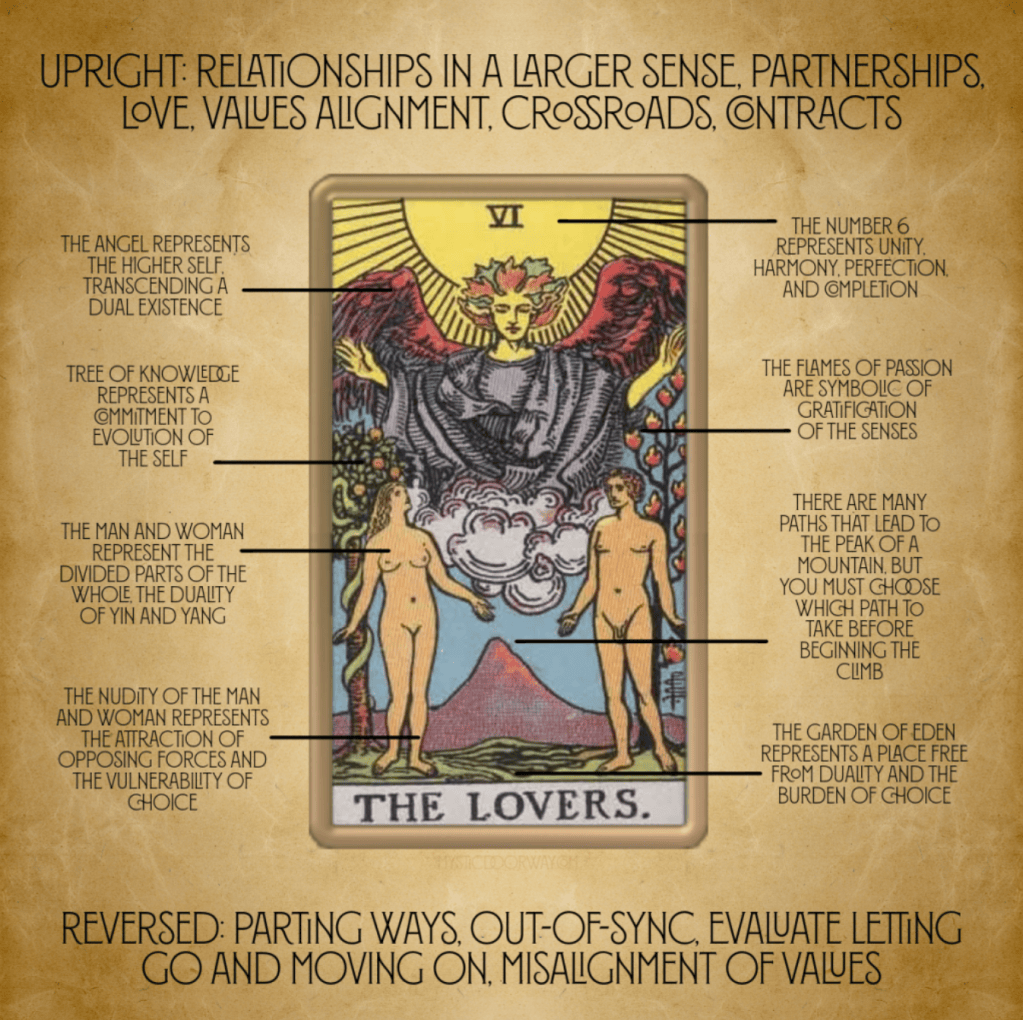
The Tarot: The Lovers