
Diving into the Nigredo
The Alchemy = Calcination | Black Charcoal
What the Fire Does
The ancient alchemists worked with actual fire.
They placed their materials in a crucible and applied sustained, intense heat – not a quick flame, but a long, deliberate burning. Everything volatile cooked away. And there is more volatile matter in a human soul than we tend to admit. The false certainties. The identities assembled from fear and longing and the need to belong. The roles grown so familiar they stopped feeling like costumes. All of it is combustible. All of it is fuel.
The fire is not cruel. It is simply thorough.What remained was called the calx: a fine, dry powder. Reduced. Essentialized. Unadorned.
This operation was called Calcinatio.
And here is the paradox the alchemists noticed: the ash weighed more than the original material. Something was not lost in the fire. Something was revealed by it.
The ash is not an ending. It is a beginning that doesn’t know itself yet.
- Where are you diving?
- Does an image emerge?
- Is there a card already in your deck?
The First Fire
The historical alchemists described four stages of heat, each one twice as intense as the last. The gentlest fire was like a brooding hen – slow, warm, and patient. The next stage is like the June sun.
Then came the great calcining fire. Fierce. Sustained. Transforming.
Calcination is not the first warming. It is the fire that means business.
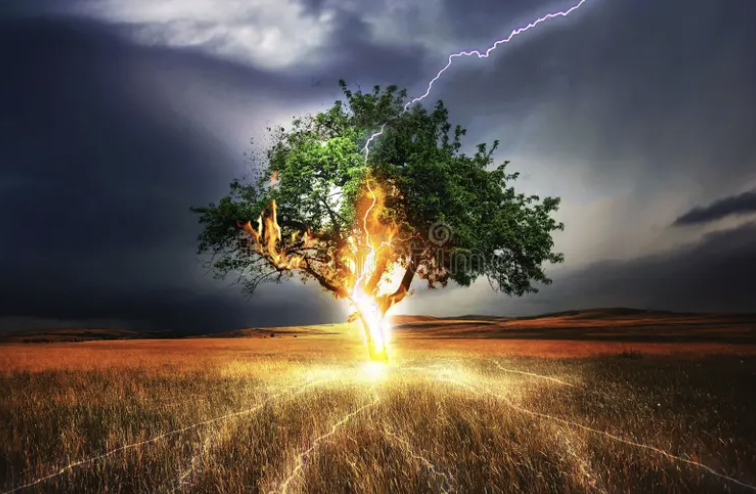
Any image containing open flame affecting a substance belongs to the calcinatio. The burning bush. The forge. The struck tower. The house that catches.
When you see fire in a dream, in a myth, in a memory that still has heat in it – you are in calcination territory.
What Gets Burned?
Not everything.
What burns is what was never truly ours to begin with. Consider the inflated story, the false certainty, the identity built on approval or fear or someone else’s idea of who we should be. The ego’s elaborate constructions. The comfortable structures that kept us small and safe and unexamined.
Jung named this territory with thoughtful precision. Calcination is the encounter with the Shadow, the confrontation with everything we have denied, repressed, or simply never examined in the light. The fire doesn’t invent anything new; it illuminates what was already there.
What remains after the burning is what Hillman called the twice-born body, a subtle body no longer attached to what it once was, free to become wholly absorbed in the work.
This is not destruction. This is clarification.
Consenting to the Heat
There is a distinction worth naming at the threshold of this moon.
Calcination can look like depression from the outside. The darkness, the reduction, the loss of what was familiar. But the alchemical tradition is insistent that this is not the same thing. Depression is being overwhelmed by the fire, the ego going under and losing its bearings. Calcination requires us to remain present to what the fire is doing, to consent to the burning, to stay awake in the heat long enough to discover what it is revealing.
Jung understood this as the difference between being consumed by the Shadow and entering into conscious relationship with it. One happens to us. The other we choose.
This is not passive suffering. It is active witnessing of our own transformation. We are not the ones being destroyed. We are the alchemists and we are also the material in the crucible, both at once.
The Tarot: The Tower
When the Lightning Comes
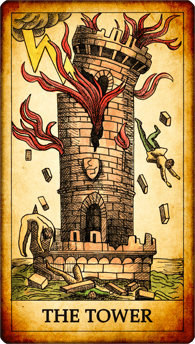
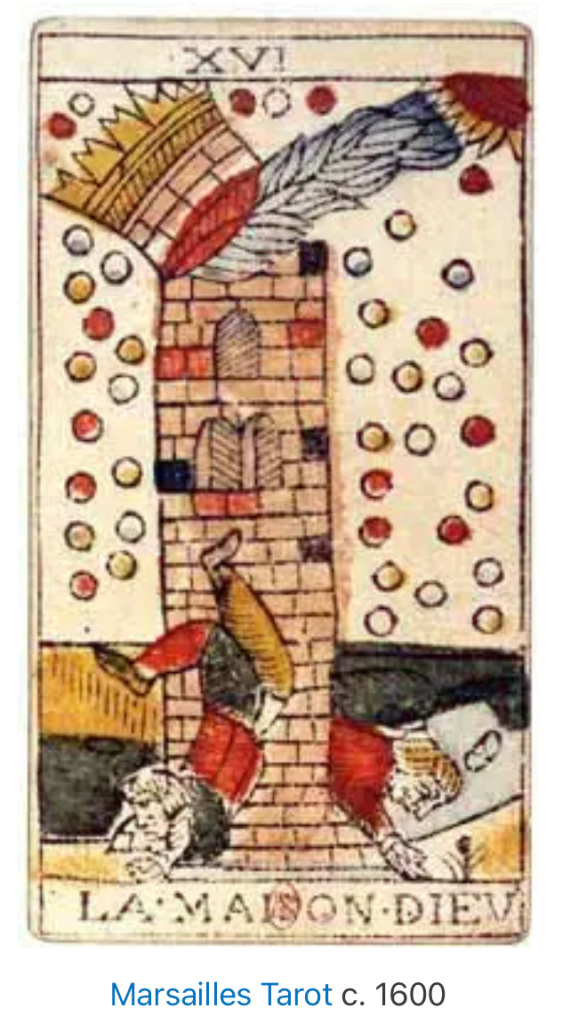
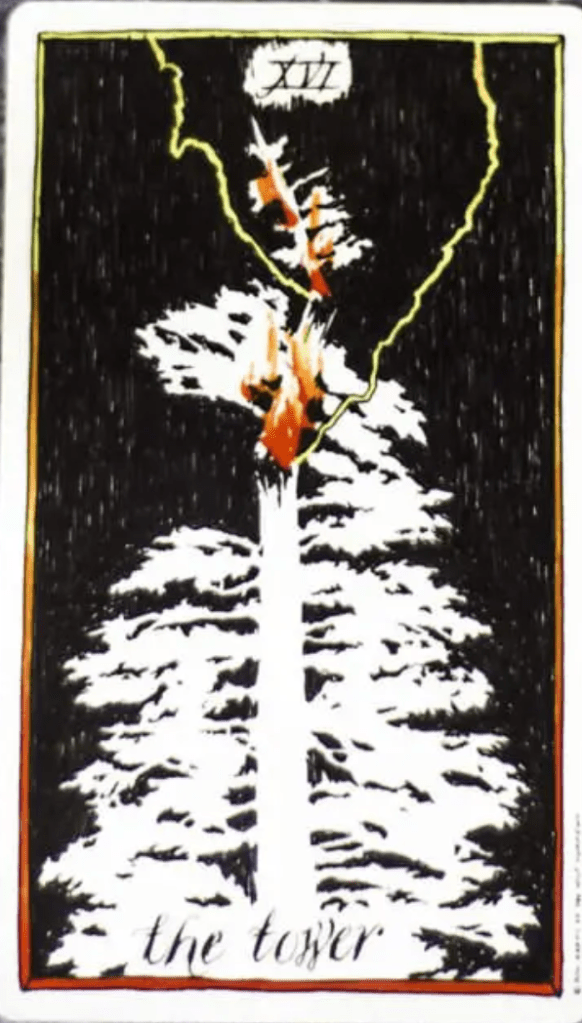
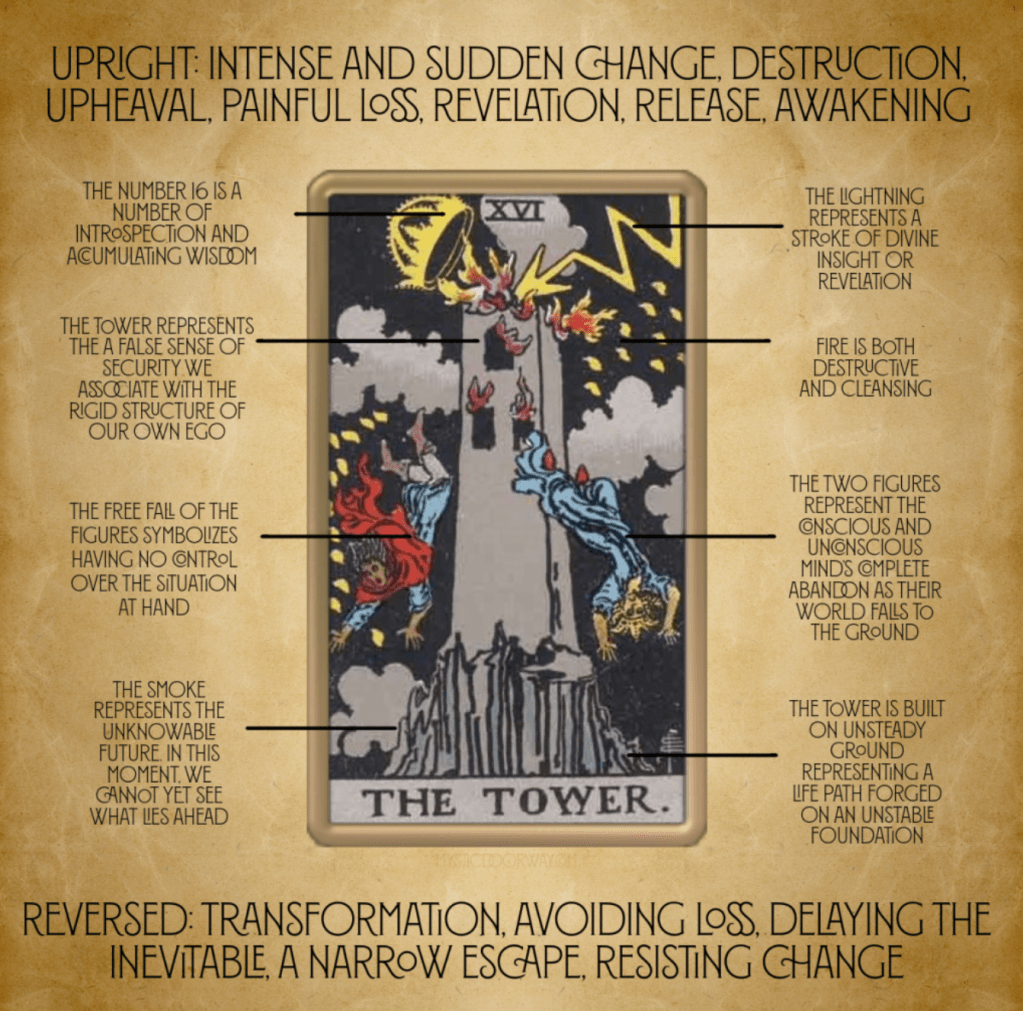
The Tower is the most dramatic image in the Tarot. A tall structure, struck by lightning, its crown blown off, two figures falling from the heights into open air.
We do not usually see it coming. Or perhaps we do not always let ourselves see it coming. Sometimes the Tower does not arrive as sudden lightning. Sometimes change has been tapping us on the shoulder for months, even years, patient and persistent. A quiet knowing we kept deferring. A restlessness we kept explaining away. A crack in the wall we kept painting over.
When we ignore the tap long enough, the lightning comes anyway.
That is part of its nature. The Tower represents the structures we have built with great care and considerable effort, the ones we believed were solid, permanent, proof against the weather. And then something strikes. A loss, a revelation, a relationship that ends, a belief that suddenly cannot hold its own weight. The crown flies off. The walls crack. We are airborne before we have decided to jump.
But look again at those two figures. They are not simply falling. There is something in the image that has always suggested the possibility of the dive.
What the Tower Was Protecting
The lightning does not strike randomly. It finds what has grown too rigid, too defended, too removed from the living ground. Jung understood this as the psyche’s own corrective force, the Self dismantling what the ego has over-built. The Tower falls because something inside it needed to be free.
This is where the Tower and Calcination meet. The fire of calcinatio and the lightning of the Tower are the same force in different forms. Both burn away what cannot last. Both reveal what was hidden inside the structure all along.
We built the Tower. We laid every stone. We know its architecture better than anyone. And so when it falls, we are not entirely without resources. We also get to choose how we meet the falling. We can brace against it, clench and resist, insisting it should not be happening. Or we can do the harder, braver thing. We can open. We can let the fall be a fall and trust that the ground, when it comes, will be real.
That choice, small as it may feel in the moment of impact, is everything. It is the difference between collapse and transformation. It is the dive.
When the dust settles, the first new blooms can emerge from the rubble.
The Liberation of Destruction
In the Tarot, the Tower represents the clearing away of negativity to make way for the spiritual ascension depicted by the final trumps…the trump represents the burning away of pride and egotism that is necessary to ascend into the Soul of Reason, It is the purification that pave the way to the Star.
ROBERT M. PLACE, The Tarot, Magic, Alchemy, Hermeticism & Neoplatonism (2017)
The Literature:
Poetry
- The Guest House by Rumi
- Revelation Must Be Terrible by David Whyte
- When Death Comes by Mary Oliver
Myth
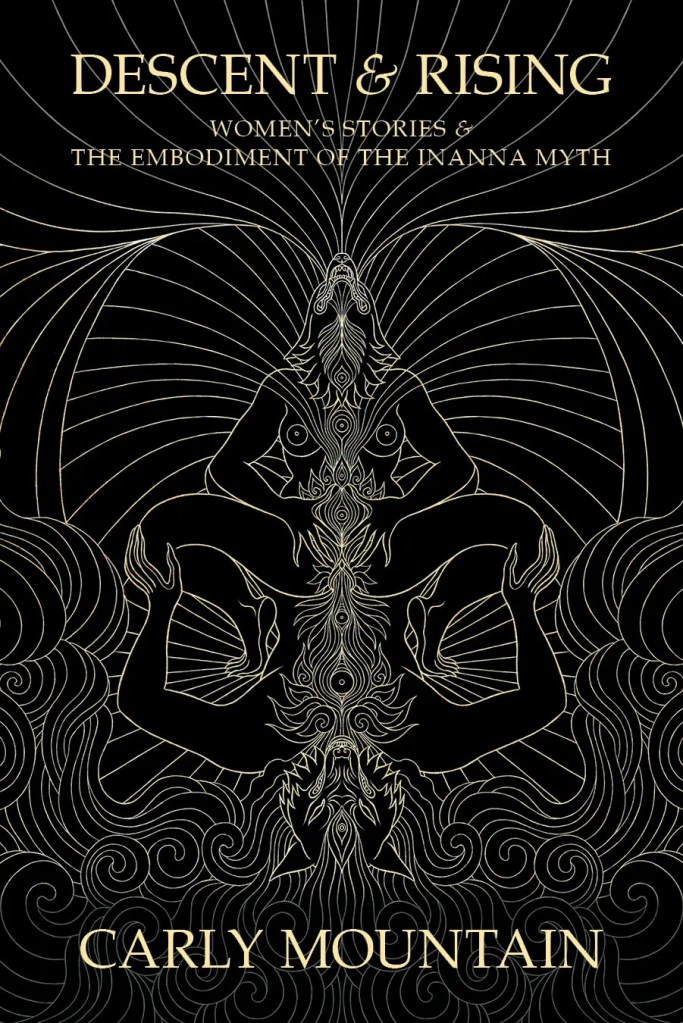
Inanna arrives at the first gate adorned in her crown, her power, her identity. She is asked to leave it all behind. She does not yet know why. She keeps going. For now we will only read through the first gate. See PDF attachment below.
Song
Leonard Cohen spent years writing Anthem. He said the song took him a decade because he kept trying to make it more hopeful than it wanted to be. In the end he let it be what it was.
The chorus holds one of the most quietly radical ideas in all of his work. Not that the crack can be repaired. Not that the crack is a flaw to be ashamed of. But that the crack is precisely where the light enters.
This is the Tower after the lightning. This is calcination after the fire.
- Anthem by Leonard Cohen – lyrics
The Ponderings:
- What has any of the literature inspired you to leave behind? Something in the literature found you. It always does. What did it stir, disturb, or illuminate?
- What are you willing to burn? What in you has been circling the fire for a long time, drawn to the heat but not yet ready to step close? What have you been tending, defending, explaining, preserving — that part of you already knows belongs to the flame?
- What would remain of you after the fire? The alchemists knew that the ash weighs more than what it came from. Something essential survives the burning, clarified, irreducible, finally itself. If the fire took everything borrowed, everything performed, everything built for someone else’s eyes… What is the self that would remain, standing in the ash, unadorned and wholly yours?
- What has been tapping on your shoulder? Before the lightning, there is always a whisper. A restlessness you have been naming as something else. A knowing you have been deferring until the time is right, until you are ready, until conditions improve. What has been patient with you long enough? What is asking, more insistently now, to be heard?
Diving Deeper after the Module Meeting
PODCAST: Inanna & Ereshkigal: The Underworld, the Hook, and the Return with Carly Mountain (March 19, 2026•Maria Souza•Season 2•Episode 10)
 The Power of Story