

We can all identify with the characteristics of the king or queen, the jester or magician, the witch, goddess, rebel, or warrior. These figures are examples of archetypes.
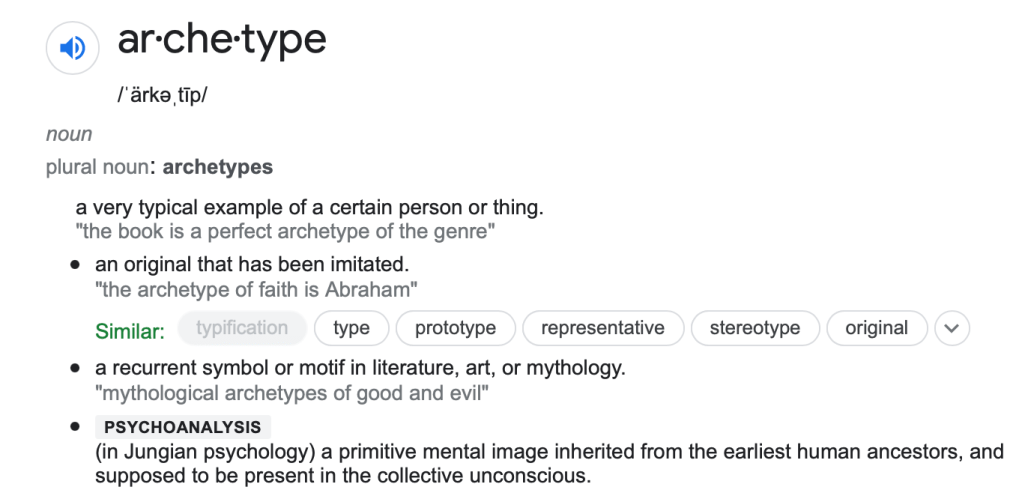
ARCHE means “first” and TYPE means “model” or “kind”. The name itself implies that these energies have been swirling since the beginning of time…
Kim Krans, artist and creator of The Wild Unkown Archetypes Guidebook and Deck (13)
There are endless lists of archetypes embedded in our language and culture. Carl Jung placed these archetypes in the collective unconscious and they take different guises in individual minds and across different cultures. Each human mind is unique, but Jung’s position is that we are all connected in the collective unconscious and he tells us that individuals become conscious and brings forth common archetypes through symbolic imagination.
It is possible that archetypes have their own agendas, their own work to do on us.
Kim Krans (2)
Archetypes are important in our everyday lives. For humans to bring forth archetypes into their lives, symbols are needed to bring into consciousness what language alone cannot clarify. Using Jung’s ideas, archetypes can come out as group beliefs within a particular culture and these can come in many forms: myths, fairy tales, dreams, fantasies, tribal life, as well as the narratives in film and television. Individuation is a term noted by Jung that outlines the development of an individual that leads to full actualization of the Self. In her book, Jungian Theory for Storytelling, Helena Bassil-Morozow tells us that “part of the individuation process…cover a comprehensive range of experiences, from falling in love to keeping alive the creative impulse”…and…”archetypes play an important role in the processes that help people explain and organize their existence”.
Humans have long been grappling with naming, understanding, harnessing, and developing the archetypes that surround and inhabit us.
Kim Krans (24)
The works of Darren Kelsey and Michael Osborn build upon Jung’s position that storytelling is at the core of collective consciousness. Kelsey points out that humans cooperate together and “this mysterious glue is made of stories, not genes”. He notes that strangers can cooperate because they have common beliefs in “goods, nations, money, and human rights. Yet none of these things exist outside the stories that people invent and tell one another”. Osborn has written extensively about archetypal metaphor in his book, Michael Osborn on Metaphor and Style. His examples will continue to build a foundation for the use of archetypes as a tool for transformational learning in adults, most notably women seeking to unlearn the societal myths that have suppressed their journeys to their true selves.
Jessica Snow works with people using meditation and art to bring archetypes from the unconscious to the conscious. In a recent interview with her I asked, “Why is it important for you to guide people to identify with archetypes in their world? Who inspired you to explore archetypes in your own journey?”
She replied:
“First as a child, I was exposed to a lot of archetypes. I saw a lot of those in the stories that I was reading. Then, when I started to meditate, I was like, Oh,we can work together.”
“In guiding people into archetypal experiences or experiences with archetypal characters, it’s so important because when we work with archetypes, we can both contain and give attention to these big energies.”
“I deeply believe that this is great work for anyone, whether you’re a real big meditator, or whether you’re a mystical type – it doesn’t matter”.
“Everybody knows who the witch is. Everybody knows who the warrior is, and everybody will have a different relationship with those archetypes, and that is such fertile ground for what I call magic, but also for growth, and all the other things that we’re talking about.”
According to Kim Krans, author and creator of the round shaped Archetypes oracle art deck, the imaginal real of imagination is the territory of the archetypes. We can find them in the spaces where everything is possible: poetry, images, and metaphor. The following are the defining characteristics of archetypes:
- Archetypes are patterns
- Archetypes are universal
- Archetypes are timeless
- Archetypes are infinite
- Archetypes contain both light and dark
- Archetypes use image
- They can never be fully captured
Krans teaches us through her art and words that archetypes have intentions. They insist on the imagination; they insist on multiplicity; and they insist on the collective. They want us to grow.
They captivate our minds and hearts so we are compelled to take the next step on our inner quest
Kim Krans (29)
Do you have any experiences with archetypes in your life? Please share.
Click into the next module


 The Power of Story
Leave a reply to Cherizé Curry Cancel reply