
Earlier in my life I struggled with a problem many women face in our modern society. I stagnated my natural feminine intuition and wisdom when I allowed myself to be influenced by societal messaging and myths. The most damaging was the myth that my purpose and worth were dependent upon fulfilling society’s demand for me to become a wife and mother.
Most of us, as consumers of story, are familiar with the plot line of the Hero’s Journey. Although many have criticized Joseph Campbell for his masculine focus, late in his career he noted that: “Many of the difficulties that women face today follow from the fact that they are moving into a field of action in the world that was formerly reserved for the male and for which there are no female mythological models” and “she may lose her own nature” because of “her biologically assigned role was to give birth and to rear children”.
In Craig Smith’s chapter, “Rhetorical Dimensions of Myth and Narrative,” he notes that “the use of sound as symbols for objects, feelings, perceptions…that is language-may have developed over 60,000 years ago”. As communities came together, myths and arguments were words that helped to make sense of the world. Smith outlines myths as rules of society to provide order and moral codes.
The Greeks understood that “the stories we spin into myths are not always national or cultural; they can be personal and serve as guides in our personal decision making”. Smith argues that our survival depends on the ability to adjust to our changing worlds and so he states, “that is why storytelling is the oldest form of rhetoric”.
Storytelling is a historical tool for making sense of experiences. Stories can lead to transformation as they challenge the beliefs of the listener. Songs and poems can shake up an individual’s assumptions and create a transformative growth experience.
In Maya Zuckerman’s article, “From the Hero’s Journey to Our Collective Journey”, she puts forth a challenge to break free from the hero myth. She draws on the work of Joseph Campbell and notes that he saw variations of the universal story structure of this cycle of life in most every culture he studied. The “hero leaves for the quest, learns from the mentor, fights the monsters, dies and resurrects, finds his power, returns with the elixir. Wash, rinse, repeat, ad infinitum”.
Zuckerman calls for alternative narratives and presents the gendered journey that is more inclusive than the traditional male dominated versions. She argues that “the perpetuated narratives of man in conflict with an enemy or in conflict with nature are no longer serving us”. She puts forth a feminine journey where the hero gathers courage and is “reborn as a complete being in charge of her own life”…and…”this journey starts by questioning authority, then gaining the courage to stand up for herself, and finally embodying the willingness to go it alone and face her own symbolic death.”
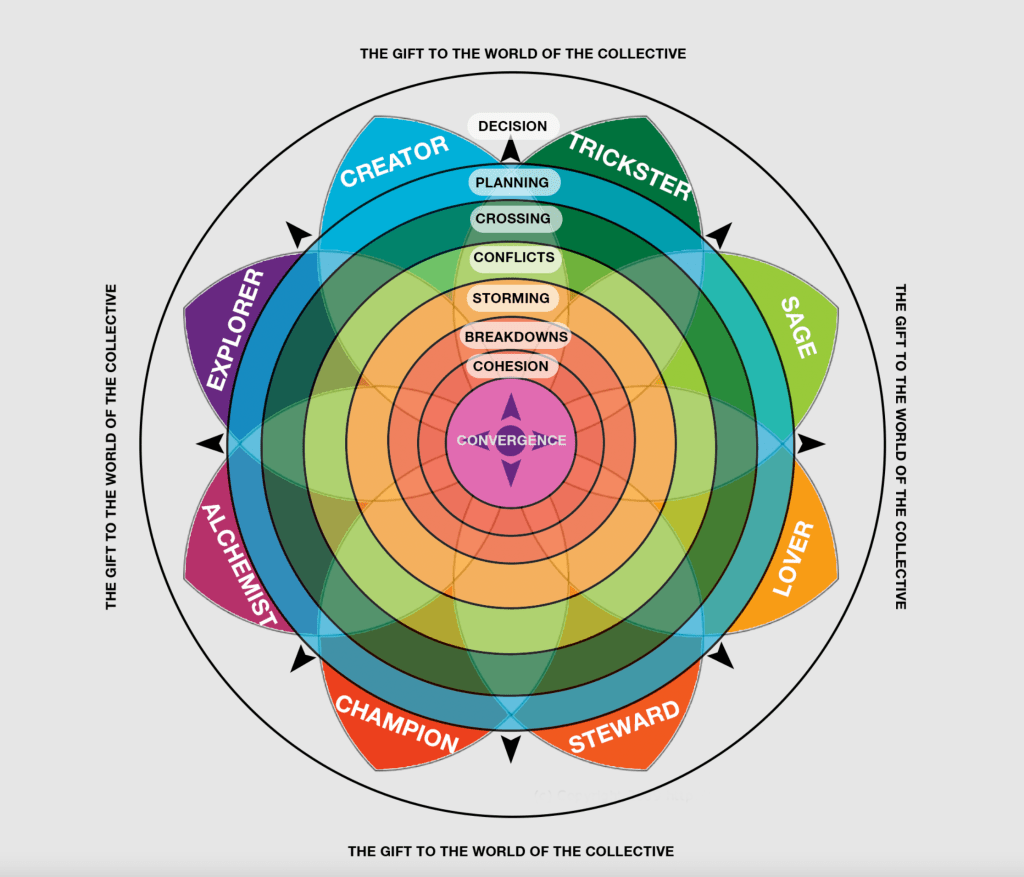
The Heroine doesn’t necessarily die and leave the world but she transforms the world for herself and others. She makes life better for all. This journey is more inclusive and “can encompass the masculine and feminine, and two-spirited journey, which can be any of the straight and LGBTQAA–lesbian, gay, bisexual, transgender, queer, asexual, ally–as well as those who experience the world as gender-neutral.”
In my recent interview with Jessica Snow she mentions that when Campbell was writing about the hero’s journey in the late 1940s, “It was a stretch even for humans of that era to recognize there might be a mystical, or, you know, archetypal element to their little human life”. She points to our current timeline and that there might be ways to expand these narratives and move away from hyper individualism.
She uses the visual of water and a pebble and that each of our actions can have a ripple effect. I agree with Jessica that as we journey through the different stages we may start a career, and then stop it, and then do something different. She concludes that if we can recognize the archetypal elements like the child, the maiden, the mother, the wise woman, the crone, we affect each other. When we deepen the understanding of our experiences in a positive way when we can share with each other and learn together.
Societal messaging can also have a negative ripple effect on our lives. When we are told that our worth is dependent upon living the ways in which traditions, the media, or influences tell us to be, it can stagnate and stall our personal journeys.
As Gianna Biscontini writes in her book Fuckless: A Guide to Wild, Unencumbered Freedom, it is time to consider the false stories (the fucks) that are holding you back. These stories are “someone else’s fears, experiences, opinion, or thoughts. They can be harmless or harmful. They almost always keep you liked”.
These narratives are barriers to our best selves and usually contain:
“You should____,”
“You can’t _____”,
“You aren’t _____enough”.
In her podcast, Insights at the Edge, Tami Simon interviews Acharya Shunya about her new book: Roar Like a Goddess, and they discuss the journey of reclaiming one’s feminine power. “After centuries of living in patriarchal societies, many women do not realize how powerful they are—on how much they’ve been encultured to keep their true nature hidden and repressed”.
Personally, I have only begun to escape this glass box. I have thrown off the lid, and I am still climbing the ladder out of the societal myths that kept me from my personal path of individuation. This management of societal expectations keeps us “busy” and wandering around a maze of dis-ease.
If we believe the work of Carl Jung, we all live together and share a collective unconsciousness, and in that place resides the archetypes that we can access as the characters that support our personal journey toward our individuation or journey to becoming ourself.
We are the heroine of our own adventure toward actualization of our authentic soul self. This is each of our own storylines. Jung called this psychological state of peace and happiness the Self and that the bumpy road or life’s challenges and obstacles is part of the pursuit to this impossible state. As they say, it is not the destination but the journey.
I propose we break away from myths and make a choice to live/write our own stories.
Click to Go Home


 The Power of Story
Leave a reply to allisonmaginn Cancel reply